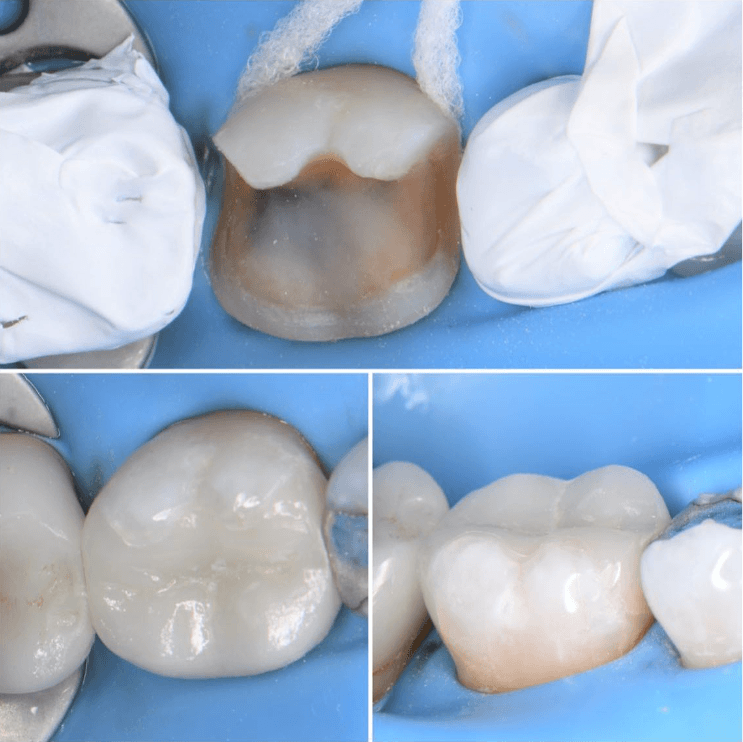
Restorative Dentistry
What is Biomimetic Dentistry — and Why Does It Change Everything?
A growing movement in modern dentistry asks a simple but radical question: what if we stopped replacing tooth structure and started restoring it instead?
Dr. Dan Malloy, DMD Restorative Dentist
May 2026 · 8 min read
Imagine a dental filling that doesn’t just patch a hole — but actually mimics the strength, flexibility, and bonding behaviour of natural tooth enamel. That’s the promise at the heart of biomimetic dentistry, a philosophy that’s quietly reshaping how forward-thinking dentists approach everything from a simple cavity to a cracked molar.
The word comes from the Greek bios (life) and mimesis (imitation). In practice, biomimetic dentistry means studying how natural teeth are designed — their layers, stress distribution, and bonding properties — and then using that knowledge to guide every clinical decision. The goal is always the same: preserve and restore, never sacrifice unnecessarily.
“The best dental restoration is the one that is most like the tooth it replaces — in structure, in strength, and in how it moves with you.”— Dr. David Alleman, Pioneer of Biomimetic Dentistry
The Problem With Traditional Dentistry
To understand why biomimetic dentistry matters, it helps to understand what traditional restorative dentistry often does instead. For most of the 20th century, dental treatment followed what’s sometimes called a “drill and fill” model — and in more serious cases, a “crown everything” model.
When a tooth had a cavity, a significant amount of surrounding healthy tooth structure was often removed to create room for a filling or to prepare for a crown. The logic made sense at the time: create a mechanically retentive shape so the restoration doesn’t fall out. But this came at a cost.
⚠ The Crown Cycle Problem
Traditional dentistry often leads to what researchers call a “restorative cycle”: a small cavity gets a filling, which eventually fails and becomes a larger filling, which leads to a crown, which may require a root canal, then an implant. Each step removes more structure. Biomimetic dentistry aims to interrupt this cycle early.
Teeth are not static blocks. They flex — very slightly — under the forces of biting and chewing. When a rigid restoration (like a traditional crown or amalgam filling) is bonded to a flexible tooth, stress concentrates at the margins. Over time, this can cause cracks, leakage, and ultimately more damage than the original cavity.
How Biomimetic Dentistry Thinks Differently
Biomimetic dentistry approaches the tooth as an engineering marvel. Natural tooth structure is made up of three distinct layers — enamel, dentin, and the inner pulp — each with different elastic properties. Enamel is hard and brittle; dentin is softer and more flexible; together they form a gradient that dissipates force beautifully.
A biomimetic restoration tries to replicate this gradient. Rather than using one rigid material cemented over prepared tooth structure, a practitioner might use a combination of adhesives and composites in layers, each calibrated to flex at a rate close to the original tooth layer it replaces.
The five core principles
01
Minimal removal
Remove only what is decayed or damaged. Healthy tooth structure is irreplaceable and worth protecting at all costs.
02
Seal the dentin
Immediately seal exposed dentin after preparation to protect the pulp from bacterial invasion and sensitivity.
03
Stress-reduced design
Use adhesive techniques and layered composites that distribute occlusal forces across the restoration naturally.
04
Mimic tooth structure
Layer materials to replicate the elastic modulus gradient from dentin to enamel, reducing crack propagation.
05
Preserve the pulp
Avoid root canals whenever biologically possible by protecting the nerve through conservative, sealed restorations.
Biomimetic vs. Traditional: A Direct Comparison
The philosophical and clinical differences between these two approaches become very clear when you look at specific scenarios side by side.
| Topic | Traditional | Biomimetic |
|---|---|---|
| Cavity treatment | Remove generously | Remove minimally |
| Cracked tooth | Crown placement | Adhesive restoration |
| Deep decay near pulp | Root canal | Dentin sealing |
| Materials used | Amalgam, PFM crowns, rigid ceramics | Layered composites, lithium discillicate onlays/inlays |
| Stress on tooth | Concentrates stress | Distributes stress |
| Long-term outlook | Often leads to crown → root canal cycle | Aims to interrupt the restorative cycle early |
What Treatments Does It Cover?
Biomimetic principles can apply across a wide range of dental treatments. At its simplest, it changes how a dentist approaches a cavity — taking the minimal amount of healthy tooth necessary rather than extending the preparation for form. But it extends further.
For cracked teeth — one of the most common yet difficult dental problems — traditional treatment often defaults quickly to a crown. A biomimetic dentist will instead look at the crack pattern, use high-powered magnification, and attempt to bond the crack from the inside using layered composite resins. Studies have shown that teeth restored this way have significantly reduced rates of pulpal exposure and root canal need.
For teeth with deep decay approaching the pulp, the biomimetic approach often involves a technique called immediate dentin sealing (IDS) and careful removal only of infected tissue, leaving the deeper affected (but not infected) dentin intact and sealing it off. This gives the pulp a fighting chance to recover rather than defaulting to extraction of the nerve.
✓ Clinical Evidence
A landmark study by Alleman and Magne (2012) found that biomimetic protocols reduced the need for root canal treatment by over 90% in cases that would have traditionally been referred. Subsequent research has continued to support preserved pulp vitality outcomes in minimally invasive cases.
Is It Right for Every Patient?
Biomimetic dentistry is not a silver bullet, and a thoughtful practitioner will always weigh the clinical picture. Teeth that are too far gone — with irreversible pulpitis, large fractures extending below the gumline, or insufficient remaining tooth structure — may still require traditional interventions. The goal is never dogma, but rather a preference hierarchy: preserve first, restore minimally, intervene only when necessary.
Cost is also a factor. Biomimetic restorations often require more clinical chair time, more advanced materials, and greater technical skill. This can make them more expensive in the short term — though proponents argue the long-term cost savings from avoiding crowns, root canals, and implants more than compensate.
Finally, it requires a dentist who has specifically trained in these techniques. When looking for a practitioner, look for one who has completed formal coursework through organisations such as the Academy of Biomimetic Dentistry (ABMD).
The Bigger Picture
At its core, biomimetic dentistry is part of a broader shift in medicine toward less invasive, more tissue-preserving care — from keyhole surgery to watchful waiting protocols. It reflects a growing understanding that the body’s own structures, when supported correctly, often outperform our best synthetic replacements.
A natural tooth is a living organ. It has sensation, blood supply, and an incredible capacity to adapt and repair itself when given the right conditions. Every time unnecessary tooth structure is drilled away, that capacity is diminished. Biomimetic dentistry simply asks: can we do better? And increasingly, the answer is yes.
Whether you’re facing a new cavity, a cracked tooth, or a recommendation for a crown, it’s worth asking your dentist about biomimetic options — or seeking a second opinion from a practitioner trained in this philosophy. Your teeth may last a lifetime. How they’re treated in the next decade will determine a great deal about what that looks like.
Questions about your dental treatment?
Speak with a dentist trained in biomimetic and minimally invasive techniques to understand your full range of options. Find a biomimetic dentist →